
Services
We Offer You…
After steel fabrication, hot dip galvanizing — wherever you are, Arabian Galvanizing Company’s services are close to you.
Hot dip galvanizing is the process of applying a zinc coating to fabricated iron and steel components by immersing the material in a furnace consisting primarily of molten zinc.
Zinc applied to iron and steel can add many years to the life of a component or facility. No other coating can match the barrier and cathodic protection that zinc provides.
Galvanizing Process
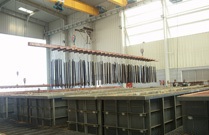 Degreasing
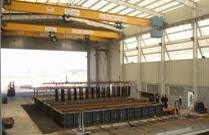 Pickling
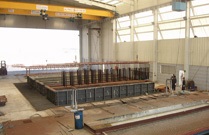 Fluxing
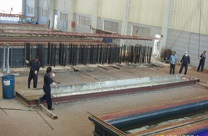 Drying
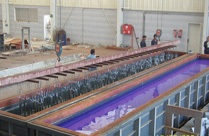 Quenching
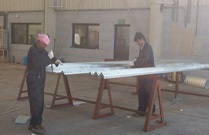 Finishing
Advantages of Galvanizing
- Galvanizing provides an abrasion-resistant coating for an exceptionally long period.
- No other protective coating can match this unique process.
- Because galvanizing coats steel with zinc at a considerably low cost and with negligible maintenance over a longer period, it is considered the most cost-effective protective coating today.
- The galvanized coating becomes part of the steel surface as it forms zinc–iron alloy layers and metallurgically bonds to the base steel.
- The corrosion rate is extremely slow compared with other conventional coatings.
- The mechanical properties of commonly galvanized steel are not affected by galvanizing.
AGC – Galvanizing Gives
Barrier Protection
If any one of the elements (anode, cathode, electrolyte or return current path) is not present, corrosion will not occur.
Cathodic Protection
A galvanized coating provides cathodic protection to exposed steel.
Cathodic Protection of Damaged Areas
Where continuity of a galvanized coating is broken by cut edges, drilled holes or surface damage, small areas of exposed steel are protected from corrosion cathodically by the surrounding coating. No touch-up is necessary, and cathodic (sacrificial) protection continues for many years. In service, zinc corrosion products tend to build up in coating discontinuities, slowing the rate at which the surrounding coating is consumed while protecting the damaged area. Practical examples include exposed cut edges in galvanized steel roofing and cladding, and the uncoated internal threads of certain fasteners.